
What Is Specialist Dementia Care? A Guide for Families in Stafford
Dementia is not simply a problem with memory. As the condition progresses, it can affect communication, decision-making, mobility, behaviour and the ability to manage everyday tasks.
For families, this can make the care increasingly complex. A person may need help with personal care while also requiring support to communicate, remain active and manage changes in behaviour or health.
Specialist dementia care is intended for people whose needs require this more considered approach. Understanding what it involves can help families and professional referrers make informed decisions about the right care environment.
What Does Specialist Dementia Care Mean?
Specialist dementia care is care that takes into account the particular difficulties dementia can cause, rather than treating the diagnosis as the only consideration.
Memory loss may be the most recognisable symptom, but dementia can also affect language, perception, judgement and orientation. Someone may struggle to recognise familiar surroundings or understand instructions that were once straightforward.
Care therefore needs to be adapted to the person's abilities. Communication may need to be simplified, routines made more predictable, and activities adjusted as abilities change.
NICE recommends person-centred care that considers an individual's history, preferences, relationships and needs. This is important because two people with the same type of dementia may experience very different symptoms.
Specialist care should also recognise when a change may indicate an underlying health problem. A sudden deterioration in behaviour, for example, can sometimes be associated with pain, infection, medication effects or another medical issue. These situations require appropriate clinical assessment rather than simply being attributed to dementia.


When Might Someone Need Specialist Dementia Care?
There is no fixed point at which someone with dementia must move into residential care.
Some people can remain at home with family support, community services or other care arrangements. Others gradually reach a point where their needs become difficult to manage safely or consistently at home.
This might happen when a person needs significant assistance with washing, dressing or eating. Mobility problems, falls, continence needs, or difficulty taking medication can add further challenges.
Changes in behaviour can also influence the decision. Repeated wandering, severe anxiety, agitation or difficulty understanding everyday situations may require more structured support.
The important issue is the person's overall needs rather than the stage of dementia alone. NHS advises that care and support should be considered according to how dementia affects everyday life and the help an individual requires.
For professional referrers, this means looking beyond the dementia diagnosis. Physical health, neurological conditions, mental health and rehabilitation needs may all form part of the assessment.
How Is Specialist Dementia Care Different From General Residential Care?
The main difference is often the level of understanding behind everyday support.
Someone living with dementia may not always be able to explain that they are uncomfortable, frightened or in pain. Changes in behaviour can therefore provide important clues.
Staff need to recognise these changes and consider what might be causing them. The response may involve adapting communication, changing the environment or seeking clinical advice, depending on the circumstances.
The physical environment can matter too. Excessive noise, unfamiliar layouts or too many choices may be confusing for someone with cognitive impairment. A calm, understandable environment can make ordinary tasks easier to manage.
Activities should also be appropriate to the person's abilities. An activity does not have to be complicated to be meaningful. Familiar music, conversation, gardening or looking through photographs may be more suitable than an activity requiring complex instructions.
This is one reason families should look beyond the label of "dementia care" when comparing settings. Ask how staff actually support someone whose memory, communication or behaviour changes.
How Can Care Teams Support Changes in Behaviour and Communication?
Behavioural changes can be particularly difficult for relatives because they may appear sudden or out of character.
A person might become restless, repeatedly ask the same question, refuse care or become distressed in certain situations. These responses can have many possible causes.
The first step is to look for the reason. Pain, constipation, infection, poor sleep, medication, hearing or vision problems can all affect how someone with dementia behaves. Environmental factors and difficulty communicating can also contribute. NICE recommends identifying and addressing possible causes of distress before considering medication specifically for behavioural symptoms.
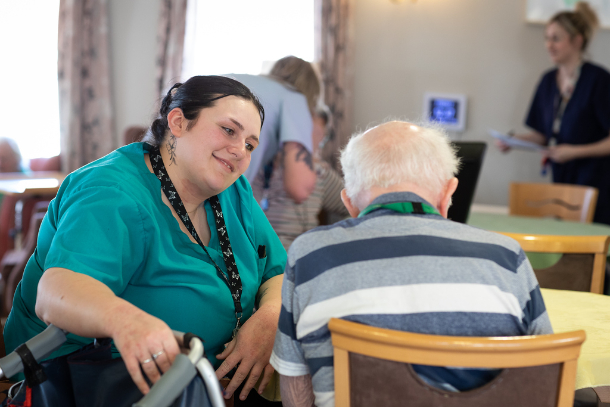
Communication should change as the condition progresses. Short sentences, simple questions and extra time to respond can make conversations easier. Speaking face-to-face and reducing background distractions may also help.
For families, this provides a useful way to judge a care setting. Rather than asking only whether staff can manage challenging behaviour, ask how they try to understand what the behaviour is communicating.


How Do Routines and Familiar Environments Support Someone With Dementia?
When short-term memory and orientation become difficult, familiar routines can provide useful structure.
Knowing what happens next can reduce the amount of information a person has to process. Regular mealtimes, familiar activities and consistent approaches to personal care may make daily life more manageable.
Routine does not mean keeping every day identical. A good routine should allow flexibility around the person's preferences, energy levels and changing abilities.
Familiarity can extend beyond schedules. Personal belongings, photographs, favourite music and familiar conversations can help staff understand the person's life before dementia became the main focus of their care.
Activities can also support identity and communication. Alzheimer's Society recommends considering a person's interests and abilities when planning activities, rather than focusing simply on keeping them occupied.
For a family member visiting a care home, this can be revealing. Look at whether residents are treated as individuals with interests and relationships, rather than simply as people receiving care.
What Should Families Look for When Visiting a Dementia Care Home in Stafford?
A visit is an opportunity to observe the care environment rather than relying solely on written information.
Notice how staff communicate with residents. Are conversations respectful? Do staff give people enough time to respond? Does the atmosphere appear calm, or does it feel rushed?
It is also worth asking practical questions. Find out how care plans are reviewed, how changes in a resident's condition are communicated to relatives and how the home works with healthcare professionals when clinical concerns arise.
Ask about staff experience and dementia training. You can also ask what happens when someone becomes distressed, refuses care or develops new needs.
The environment deserves attention. Consider whether there are quieter spaces, accessible communal areas and opportunities for residents to spend time outdoors where appropriate.
That broader provision may be relevant when dementia occurs alongside other significant health or support needs. However, suitability should always be considered against the individual's assessed requirements.
How Can Families and Professional Referrers Support a Successful Move Into Care?
Moving into care can be unsettling, particularly for someone who has difficulty processing unfamiliar information.
Preparation can make the transition easier. Families can provide information that may not appear in a clinical assessment, such as how the person likes to start their morning, which foods they avoid, what music they enjoy or what usually causes anxiety.
These details help staff understand the person as an individual rather than relying solely on a diagnosis.
It is also useful to explain changes in behaviour. A family member may recognise that someone becomes unsettled when tired or that they communicate discomfort through restlessness rather than words.
Professional referrers can contribute by ensuring relevant clinical information accompanies the person and that the receiving team understands current care requirements.
After the move, communication remains important. Needs can change as dementia progresses, so care arrangements should be reviewed rather than treated as permanent.

Frequently Asked Questions
Is specialist dementia care only for people with advanced dementia?
No. The level of care required depends on the individual's needs, not simply the stage or type of dementia. Some people may need specialist support earlier because of additional physical, neurological or behavioural needs.
What happens if someone with dementia becomes distressed?
Staff should first consider what may be causing the distress. Pain, illness, medication, communication difficulties and environmental factors can all play a role. Any suspected medical problem should be assessed appropriately.
Can people with dementia still take part in activities?
Yes. Activities can support communication, social interaction and a sense of identity. They should be matched to the person's interests, abilities and stage of dementia rather than based on age or diagnosis alone.
What should I ask a care home about dementia support?
Ask about staff experience and training, care planning, communication, managing behavioural changes, activities and how families are involved. It is also helpful to ask how the home responds when a person's needs change.
How can families help after a move into care?
Share practical knowledge about the person's routines, preferences, relationships and communication style. Continue familiar activities and maintain regular contact where possible. This information can be valuable when someone is adjusting to a new environment.
Choosing dementia care is ultimately about finding an appropriate level of support for the person's current needs while recognising that those needs may change. Families and professional referrers can arrange a conversation with Limewood Care Home in Stafford to discuss whether its specialist care provision may be suitable.